
 English
 中文简体
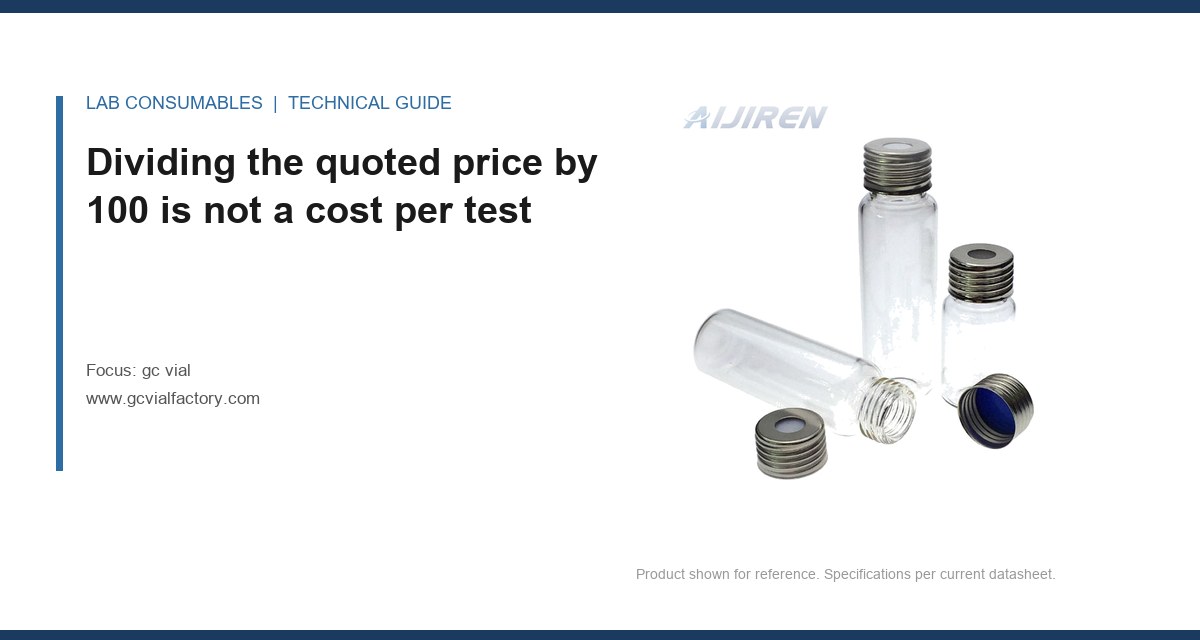
A procurement manager sent me a spreadsheet last quarter showing two 9 mm screw-thread vials: one at $0.11 per unit and one at $0.19 per unit. She had already decided to switch to the cheaper one. Then I asked how many vials her lab consumed per 100 reported results, and she did not have that number. When we pulled the batch records, the answer was 118 for the cheap vial and 104 for the more expensive one, and the cheap vial carried a 6.2% reject rate on the autosampler. The gc vial cost per test calculation is not the quotation divided by the box count. It is the total consumable spend divided by the number of results that actually leave the lab with a signature on them, and those two numbers diverge by 30% to 60% more often than most buyers expect.
The unit price on a purchase order covers one thing: a piece of glass with a cap on it. The cost per reported result covers the vial, the cap, the septum, the solvent, the internal standard, the analyst’s time to prepare and load it, the instrument time to run it, the time to re-prepare and re-run it when the injection fails, and the time to investigate and document the failure. Most of those costs are fixed per injection attempt, not per unit purchased. A cheap vial that fails one time in twenty does not save you the difference in unit price. It converts a fixed cost into a variable one and charges you instrument time for the privilege.
I run the calculation on a per-batch basis, not per vial. Take a batch of 100 samples, each prepared in duplicate, so 200 injections. If your reject rate on the autosampler is 2%, you prepare and inject 204 vials. If it is 8%, you prepare and inject 216. The extra 12 vials cost almost nothing. The extra 12 injections cost instrument time, and if the failure is discovered after the run, they cost a full re-run of the batch. That is where the money goes.
Two things drive the spread between the cheap and expensive grade: the reject rate on the autosampler, and the rerun rate after the run. Both are measurable. Neither appears on a quotation.
The four cost buckets that sit outside the unit price
When I build a cost model for a customer, I break consumable spend into four buckets. Only the first one appears on the invoice.
Bucket 1: consumable spend per injection attempt
Vial, cap, septum, and the aliquot of sample. On a 2 mL clear glass 9 mm screw-thread vial with a bonded silicone/PTFE septum, the consumable is around $0.15 to $0.25 per injection attempt at 2024 pricing. The sample aliquot is usually the larger number, especially when the sample is a derivatized extract that took 40 minutes to prepare. This is the bucket the buyer sees. It is the smallest one.
Bucket 2: prep time per injection attempt
Pipetting, dilution, internal standard addition, capping, and loading into the tray. On a typical bench, a trained analyst handles 30 to 45 seconds per vial for a simple dilution series, and 2 to 4 minutes for a derivatized or extracted sample. At a fully loaded analyst rate of $60 to $90 per hour, that is $0.50 to $1.00 per vial for simple work, and $2.00 to $6.00 for complex work. This bucket is 3 to 20 times the consumable cost. It is also the bucket that a failing vial multiplies, because a rejected injection means re-preparing the sample from scratch.
Bucket 3: instrument time per injection
A GC run is 12 to 45 minutes of instrument time, and the instrument is the most expensive thing in the lab. At a fully loaded cost of $25 to $60 per instrument-hour (depreciation, service contract, gases, electricity, and the analyst’s attention), a 20-minute run costs $8 to $20. A failed injection that is caught before the run wastes a fraction of that. A failed injection that is caught after the run wastes the full amount plus the re-run. This is why the reject rate matters more than the unit price: a 5% reject rate on a $0.15 vial adds $0.40 to $1.00 per injection attempt in instrument time alone.
Bucket 4: investigation and documentation
When an injection fails, someone has to decide whether it was the vial, the sample, the inlet, or the method. That decision takes 15 to 60 minutes and generates a deviation record. Under a regulated workflow (USP <621> for chromatography system suitability, or an ISO 17025 quality system), the record has to be closed, and if the failure mode is systemic, the method may need a corrective action. This bucket is hard to assign a number to, but it is real, and it is the one that makes lab managers stop buying the cheap vial.
How reruns, rejects and prep time change the cost per reported result
Here is the model I use. It is a comparison of two grades of 9 mm screw-thread vial, both with a bonded silicone/PTFE septum, both clear glass, both 12 x 32 mm, both fitting the same autosampler. The only difference is the manufacturing tolerance and the septum quality.
| Cost component | Economy grade | Precision grade |
|---|---|---|
| Unit price (vial + cap + septum) | $0.11 | $0.19 |
| Autosampler reject rate (measured) | 6.2% | 1.4% |
| Post-run rerun rate (measured) | 3.1% | 0.6% |
| Vials consumed per 100 reported results | 118 | 104 |
| Consumable cost per 100 results | $12.98 | $19.76 |
| Prep time per 100 results (45 s/vial, $75/h) | $110.63 | $97.50 |
| Instrument time per 100 results (20 min, $40/h) | $144.67 | $125.33 |
| Investigation/documentation per 100 results | $62.00 | $12.00 |
| Total cost per reported result | $3.30 | $2.55 |
The cheaper vial is 42% cheaper per unit and 29% more expensive per reported result. The consumable line on the invoice is 4% of the total cost. The other 96% is what the vial does to the rest of the workflow. This is the number a procurement manager should be buying on, and it is the number almost nobody asks for.
The table is a model, not a universal truth. The reject and rerun rates are the two inputs that determine the answer, and they vary by autosampler, by method, and by how the vial is handled. The way to get the real number is to measure your own rates for a month on each grade. The way to get a defensible number for a tender is to ask the supplier for a batch-specific certificate of analysis with the dimensional tolerances and the septum durometer, then verify it on a sample of 50 vials. A certificate without a test method attached is not a measurement. It is a claim.
Field case: the reject rate that turned out to be a crimp dimension
A contract lab running 350 samples a day on a 9 mm crimp-neck autosampler saw its reject rate climb from 1.8% to 5.4% over six weeks. The vials were from the same supplier, same lot family, same certificate. The analyst had already replaced the inlet liner, the septum on the inlet, and the syringe, and the rate did not move.
We measured the crimp. The neck diameter on the affected vials was 8.06 mm with a standard deviation of 0.04 mm, against a specification of 8.00 ± 0.02 mm. The mean was inside the tolerance band but the process was drifting, and roughly 12% of the vials were outside the upper limit. The autosampler gripper was lifting those vials by a few tenths of a millimeter, which was enough to misalign the needle on the septum. The needle was coring the septum instead of piercing it, and the resulting partial injection produced a peak area RSD of 4.8% on the internal standard, well outside the 2.0% system suitability limit.
The fix was not a new autosampler. It was a dimensional check on incoming lots and a change to a supplier that held the neck diameter to 8.00 ± 0.015 mm with a documented Cpk above 1.33. The reject rate went back to 1.6%, and the internal standard RSD dropped to 1.1%. The unit price went up by $0.03. The cost per reported result went down by $0.71. That is the whole argument in one number.
Field case: the rerun rate that was really a septum puncture count
A pharmaceutical QC lab was running a 40-minute GC method on a 2 mL vial with a pre-slit silicone/PTFE septum, and the rerun rate was 4.2%. The failures were not rejected injections. They were runs that completed and then failed system suitability on the tailing factor, or produced a split peak on the early-eluting analyte.
We pulled the septa from the autosampler tray after the run and counted punctures under a loupe. The pre-slit septum was rated for a single puncture, but the lab’s autosampler was double-injecting (a method artifact, not a vial defect), so each septum saw two punctures. The second puncture on a pre-slit septum opens the slit wider, and the resulting leak changes the headspace pressure during the injection. The early-eluting peak split because the carrier gas flow transient changed the retention time by 0.04 minutes, which was enough to resolve the peak into two.
The fix was to switch to a non-slit silicone/PTFE septum rated for three punctures at the same 20 mm diameter, and to correct the double-injection in the method. The rerun rate fell to 0.7%. The unit price of the septum went from $0.06 to $0.09. The instrument time saved was 3.5 runs per 100, which at 40 minutes and $40 per hour is $9.33 per 100 results. The septum cost increase was $0.36 per 100 results. The lab recovered the difference 26 times over.
This is the kind of thing that does not show up on a price comparison. It shows up when you count punctures, or when you measure the peak area RSD, or when you track the rerun rate by lot. If you are not tracking the rerun rate by lot, you cannot see it at all. For a broader treatment of how the septum behaves under repeated puncture, the cored-septum article on this site covers the mechanism.
What to actually measure before you switch suppliers
You cannot run the cost per test calculation without four numbers. Get them before you compare quotations, not after.
- Reject rate on the autosampler. Count the injections that the instrument refuses to start, or that abort within the first minute. This is the easiest number to get and the one most labs ignore.
- Post-run rerun rate. Count the runs that complete but fail system suitability. This is the expensive one, because it consumes the full instrument time before the failure is discovered.
- Prep time per vial. Time 20 vials with a stopwatch. Do not estimate. The estimate is wrong by 30% to 50%.
- Investigation time per failure. Time the deviation record from open to close, including the analyst, the reviewer, and the QA sign-off. This is the number that makes quality managers care about the vial.
With those four numbers, the calculation is arithmetic. Without them, the procurement decision is a guess dressed up as a spreadsheet.
Why the grade of the vial changes the reject and rerun rates, not the unit price
The difference between an economy vial and a precision vial is not the glass. It is the tolerance on the neck, the concentricity of the bore, the durometer of the septum, and the flatness of the cap. Each of those maps to a specific failure mode on the autosampler, and each failure mode has a cost.
A neck diameter that drifts outside 8.00 ± 0.02 mm causes gripper misalignment, which causes needle coring, which causes partial injections. A bore concentricity that drifts outside 0.15 mm causes the needle to scrape the inside of the neck, which sheds glass particles into the sample. A septum durometer below 45 Shore A causes the septum to extrude under the cap torque, which changes the headspace volume and shifts retention times. A cap that is not flat within 0.1 mm causes the vial to sit at an angle in the tray, which changes the injection depth.
None of those failure modes shows up in a unit price comparison. All of them show up in the reject and rerun rates. The grade of the vial is a decision about which failure modes you are willing to pay for. If you are running 50 samples a day on a single autosampler, the economy grade may be fine, because a 5% reject rate costs you 2.5 re-injections a day and you have slack in the schedule. If you are running 350 samples a day on a three-instrument bench, the same reject rate costs you 17.5 re-injections a day and you do not have slack. The vial that is right for the first lab is wrong for the second, and the cost per reported result is the number that tells you which lab you are.
A decision checklist for the procurement file
Before you sign a supply agreement, put these on one page and keep it with the contract. The sibling article on this site covering freight, duty and contract terms handles the commercial side; this list is about the technical cost drivers.
- Neck diameter tolerance: 8.00 ± 0.02 mm for 9 mm crimp, 8.00 ± 0.015 mm for precision grade. Verify on 50 vials from the incoming lot with a calibrated micrometer.
- Bore concentricity: ≤ 0.15 mm. Verify with a pin gauge or an optical comparator.
- Septum durometer: 45 to 55 Shore A for silicone/PTFE. Ask for the batch-specific value, not the catalog value.
- Septum puncture rating: match to your autosampler’s injection count per vial. Pre-slit is one puncture; non-slit silicone/PTFE is typically three.
- Cap torque: 1.2 to 1.5 N·m for a 9 mm screw cap, measured with a torque tester on 10 vials per lot. Over-torque extrudes the septum; under-torque leaks.
- Temperature rating: 200 °C continuous for silicone/PTFE, 250 °C short-term. Confirm against your inlet and oven program.
- Certificate of analysis with test method: the certificate must name the method (for example, dimensional measurement per ISO 1101, durometer per ASTM D2240) and the batch-specific values. A certificate without a method is not a measurement.
- Reject and rerun rate baseline: recorded for the incumbent grade over at least 30 days. This is the number you are trying to beat.
If the supplier cannot provide the batch-specific values with the method, the grade is not a grade. It is a label. For a deeper look at what a certificate actually certifies, the article on this site on certificate of analysis covers it; the short version is that the certificate is only as good as the test method behind it. The U.S. EPA SW-846 test methods and the instrument vendor documentation from Agilent, Thermo Fisher, and Restek all specify the container and septum requirements that the certificate should be measured against.
Where the calculation goes wrong in practice
Three mistakes show up in almost every cost per test model I review.
The first is using the catalog unit price instead of the landed unit price. That is a commercial matter, and the sibling article covers it. The second is using the nominal sample count instead of the injected count. If you prepare in duplicate, your injected count is double your sample count, and the reject rate applies to the injected count, not the sample count. The third is ignoring the investigation time. A 5% reject rate on 200 injections is 10 failures. At 30 minutes per investigation and a $75 per hour loaded rate, that is $375 per batch. On a batch of 100 samples, that is $3.75 per sample in investigation time alone, which is more than the entire consumable line for the batch.
The fourth mistake, which is less common but more expensive, is comparing grades from different suppliers without normalizing the septum. A $0.11 vial with a 1.5 mm silicone septum and a $0.19 vial with a 1.0 mm silicone/PTFE septum are not the same product, and the cost per test is not comparable. Normalize the septum material, the thickness, the durometer, and the puncture rating before you compare the unit price. If you are running a method that requires a PTFE-faced septum for solvent compatibility, the economy grade may not qualify at all. The article on this site on material selection for solvent and temperature covers that decision.
The rule I use
Buy on cost per reported result, not on cost per unit, and calculate it from your own reject rate, rerun rate, prep time, and investigation time. If you do not have those four numbers, run a 30-day measurement on the incumbent grade before you evaluate any quotation. The grade that wins is the one with the lowest total cost per reported result at your sample volume, not the one with the lowest unit price. For a lab running fewer than 100 injections a day with slack in the schedule, the economy grade is often the right answer. For a lab running more than 200 injections a day on a tight schedule, the precision grade pays for itself within the first month, and the unit price difference is a rounding error against the instrument time it saves. The vial is a small part of the cost per test. It is a large part of the variance. Buy the variance down. The GC vial product line at gcvialfactory.com is specified with the tolerances in the checklist above, and the same tolerance discipline applies across the HPLC autosampler vial and sample vial ranges if you are standardizing across instruments. If your prep bench also handles reagents, the reagent bottle range uses the same glass and closure specification, which matters when you are trying to hold one tolerance standard across the whole bench.
References & further reading
Related resources from our lab consumables network:
- Gc Vial at gcvialfactory.com
- Reagent Bottle at reagentbottleforsale.com
- Hplc Autosampler Vial at hplcautosamplervials.com
- Sample Vial at samplevialprice.com
External references and standards: