
 English
 中文简体
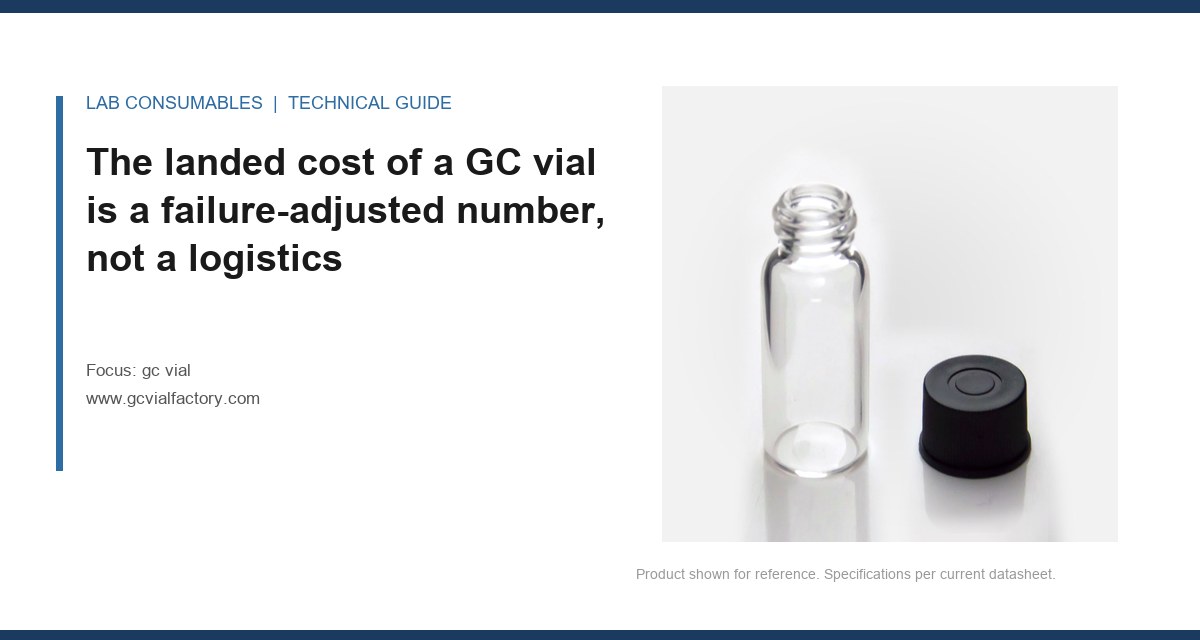
A lab manager I worked with once told me his GC vials cost $0.11 each. Six months later, after two failed sequences, a rejected data package, and a rushed replacement order from a distributor, the real number was $0.83 per usable vial. That gap is what a gc vial landed cost calculation exists to close. Unit price is the easiest number to get and the least useful one to manage.
The landed cost of a GC vial is a failure-adjusted number, not a logistics number
Most procurement teams treat landed cost as invoice price plus freight, duty, and insurance. For a GC vial, that stops too early. A vial that arrives intact but fails in the autosampler has a landed cost that includes the freight on the replacement, the labor to re-run the sequence, and the column time burned on a void injection. The only number that matters is cost per usable unit, where usable means the vial survives the entire analytical workflow without causing a retest.
I calculate landed cost this way:
- Acquisition cost: unit price, freight, duty, customs brokerage, bank fees, currency spread
- Inspection cost: incoming QC labor, sampling plan time, equipment time, rejected lot handling
- Storage and handling cost: warehouse space, climate control, inventory carrying cost, breakage in storage
- Failure cost: autosampler jams, cored septa, non-level vials, leached residues, re-runs, data invalidation
Failure cost is the bucket procurement ignores because it lands in the lab budget, not the purchasing budget. But it is real, and it is often larger than the other three combined.
A worked example: $0.11 unit price becomes $0.71 per usable vial
Let me build the full calculation for a 2 mL clear glass 9 mm screw-top GC vial with PTFE/silicone septa, ordered in a 10,000-piece lot from an overseas manufacturer.
Acquisition cost
- Unit price: $0.11
- Freight (air, 10 cartons, 120 kg gross): $1,180 total, $0.118 per vial
- Duty rate (HTS 7017.90, glass laboratory ware): 5.2% on CIF value of $1,100 plus freight, so $118.56 total, $0.012 per vial
- Customs brokerage and documentation: $95 flat, $0.0095 per vial
- Bank wire and currency spread: $60, $0.006 per vial
Acquisition total: $0.2555 per vial. Already more than double the unit price.
Inspection cost
A proper incoming inspection for a 10,000-piece lot uses ISO 2859-1, General Inspection Level II, AQL 0.65 for critical defects. That means you pull 200 vials. You measure neck ID on 50 of them with a pin gauge set, check septum hardness on 50, and run a visual inspection on all 200 under a 3x magnifier. Labor at $40/hour for 4 hours is $160. Equipment amortization and gauge calibration add $40. Rejected lot handling (if one lot in five fails) adds $32 amortized. That is $232 per lot, or $0.0232 per vial.
Storage and handling cost
If your lab holds a 6-month supply, the carrying cost is about 12% of inventory value per year, so 6% for the holding period. On an acquisition cost of $0.2555, that is $0.0153 per vial. Warehouse space for one pallet position at $18 per month for 6 months, allocated across 40,000 vials, adds $0.0027 per vial. Breakage in storage, if you lose 0.5% to chipped necks and cracked bodies, adds $0.0013 per vial. Storage total: $0.0193 per vial.
Failure cost
This is where the number moves. Based on my own experience with a mid-tier overseas supplier, here is what a 1.5% failure rate actually costs.
A failed vial means one of several things: the autosampler turret jams because the vial OD is out of tolerance, the septum cores and drops a piece of PTFE into the sample, the vial sits tilted in the tray and the needle misses the center, or the glass leaches sodium into a DMSO extract. Each failure mode has a different cost.
- Autosampler jam: 20 minutes of operator time to clear, $13.33 at $40/hour, plus 30 minutes of column re-equilibration, $15 of carrier gas and consumables
- Cored septum: the injection is void, the data point is lost, the sample must be re-prepared, $18 in labor and solvent
- Out-of-level vial: the needle hits the cap, bends, and the bent needle damages the septum on the next injection, $45 for needle replacement plus 25 minutes of downtime
- Leached residue: the entire sequence is invalidated, 12 samples re-run, $210 in labor, solvent, column lifetime, and detector time
If 1.5% of 10,000 vials fail, that is 150 failures. A typical distribution is 60 jams, 50 cored septa, 30 level issues, and 10 leached-residue events. The weighted cost is:
- 60 jams at $28.33 each: $1,699.80
- 50 cored septa at $18 each: $900
- 30 level issues at $58 each: $1,740
- 10 leached-residue events at $210 each: $2,100
Total failure cost: $6,439.80 per 10,000 vials, or $0.644 per vial. That is nearly six times the unit price.
Full landed cost: $0.2555 + $0.0232 + $0.0193 + $0.644 = $0.942 per usable vial. The $0.11 vial costs $0.94 when you account for what actually happens in the lab. A reliable supplier at $0.18 per vial with a 0.2% failure rate lands at $0.31 per usable vial. The cheaper unit price loses by a factor of three.
Freight and duty are predictable; the supplier’s process control is not
Freight from Shanghai to a US port on a 120 kg air shipment is $9.80 per kg. Duty on glass laboratory ware under HTS 7017.90.10 is 5.2%. Those numbers are fixed. What varies is the failure rate, and the failure rate is a function of what the factory controls on the line.
I have visited factories where the vial forming machine runs 24 hours with no dimensional feedback loop. The operator checks OD once per shift with a caliper. That is not process control. That is a lottery. A vial that drifts from 11.6 mm to 11.75 mm OD will still look fine in a hand inspection but will jam a tray that was machined for 11.6 mm ±0.05 mm. The Gc Vial you buy is a tolerance stack, not a glass tube.
When you compare suppliers, ask for the dimensional capability study, not the certificate of analysis. A CofA tells you what one lot measured. A capability study tells you what the process produces over 30 days. The difference is the failure rate you will import.
The inspection you skip is the failure cost you inherit
Incoming inspection feels like overhead until you calculate what it prevents. A $232 inspection on a 10,000-piece lot that catches a 3% failure rate before the vials reach the autosampler saves $1,932 in failure cost. That is an 8.3x return on inspection labor.
The inspection plan must target the failure modes that matter. For a 9 mm screw-top GC vial, I measure these parameters:
- Neck ID: 8.0 mm ±0.05 mm, measured with a two-point bore gauge on 50 vials per lot
- Vial OD: 11.6 mm ±0.05 mm, measured with a micrometer on 50 vials per lot
- Vial height: 32.0 mm ±0.25 mm, measured with a height gauge
- Septum hardness: 45-55 Shore A for PTFE/silicone, measured on 50 septa per lot
- Septum thickness: 1.3 mm ±0.1 mm for the PTFE layer, 1.5 mm ±0.1 mm for the silicone layer
- Cap torque retention: seal at 18-22 in-lbs, verify no backing off after 24 hours on 20 caps per lot
- Residual solvent: headspace GC at 120°C for 30 minutes, less than 0.1 ppm each of toluene, xylene, and ethylbenzene
If your supplier cannot meet these numbers on a capability study, no amount of incoming inspection will fix the process. You are just sorting scrap at your own expense.
Storage cost is a function of order quantity, and order quantity is a function of trust
A lab that trusts its supplier orders a 3-month supply. A lab that does not trust its supplier orders a 12-month supply and pays for the warehouse space, the carrying cost, and the risk of a lot going bad in storage. I have seen labs hold 18 months of vials because the purchasing manager got burned once and never renegotiated the supplier relationship.
The storage math is straightforward. At $0.2555 acquisition cost, a 12-month supply of 40,000 vials ties up $10,220 in inventory. At 12% annual carrying cost, that is $1,226 per year. A 3-month supply ties up $2,555 and costs $307 per year to carry. The difference is $919 per year, which is enough to fund the incoming inspection program for four lots.
Storage conditions also matter. PTFE/silicone septa degrade above 40°C. If your warehouse hits 45°C in August, the silicone layer oxidizes and the septum loses resealability. A vial stored for 12 months at 45°C will core on the first injection. The failure cost lands months after the purchase order, which is why nobody connects the two.
The Reagent Bottle you store next to your vials has the same issue. Glass and polymer components have a shelf life that starts at the factory, not at your receiving dock.
Field case: the $0.09 vial that cost $14,000 in one month
A contract testing lab switched to a low-cost supplier for 2 mL screw-top GC vials. Unit price dropped from $0.16 to $0.09. The lab ran 400 samples per day, six days per week. Within two weeks, the autosampler on their Agilent 7890 started jamming twice per shift. The operator spent 40 minutes per shift clearing jams. At $40/hour loaded labor, that is $26.67 per shift in labor alone. Over 24 shifts per month, that is $640.
But the real cost was the column. The jams caused void injections that pushed air through the column. The column, a 30 m x 0.25 mm x 0.25 µm DB-5, normally lasts 6 months. It failed in 5 weeks. Replacement cost: $650. The lab also lost 11 samples to cored septa, which required re-extraction and re-analysis. Solvent, labor, and instrument time: $1,100.
Total monthly cost of the switch: $2,390 in direct failure cost, plus a rejected data package for a client that cost $11,600 in re-runs and contract penalties. The lab switched back to the $0.16 supplier after one month. The $0.09 vial had a landed cost of $0.61 per usable vial. The $0.16 vial had a landed cost of $0.28.
Field case: the duty-free shipment that was not duty-free
A university lab ordered 5,000 vials from a supplier in Germany. The supplier shipped DDP, which means the supplier pays duty and the buyer pays nothing at the border. The lab’s procurement team assumed the landed cost was the invoice price plus nothing. But the supplier’s freight forwarder classified the vials under HTS 7010.90, which covers glass containers for packing, at a 0% duty rate. The correct classification for laboratory glassware is 7017.90.10, at 5.2%.
Six months later, the customs broker flagged the misclassification during an audit. The lab owed $286 in back duty plus a $150 penalty. The supplier refused to pay because the DDP terms ended at delivery. The lab paid $436 on a $550 order. That is a 79% increase in landed cost from a classification error that no one checked because the unit price was already low.
The lesson: verify the HTS code before you order, not after the audit. A Hplc Autosampler Vial and a GC vial often share the same HTS code, but a glass jar for cosmetics does not. The difference is 5.2% of your CIF value.
Septum failure is the single largest landed cost driver
The glass body of a GC vial rarely fails. It is the septum that cores, leaks, or leaches. A septum costs $0.02 to $0.05 of the vial assembly, but a septum failure can invalidate a $200 sample run. The economics are brutal.
PTFE/silicone septa fail in three ways:
- Coring: the needle punches a hole instead of piercing, leaving a PTFE disc in the sample
- Leakage: the septum does not reseal after the needle withdraws, causing sample loss and carrier gas dilution
- Leaching: the silicone layer releases siloxanes into the sample, which appear as ghost peaks in the chromatogram
Coring is a function of needle type and septum hardness. A 23-gauge bevel-tip needle cores a soft septum. A 26-gauge cone-tip needle pierces a 55 Shore A septum cleanly. If your method uses a 23-gauge needle, you need a septum at 55-60 Shore A. If you use a 26-gauge needle, 45-50 Shore A is fine. The wrong combination is a failure cost you pay on every injection.
The puncture count matters too. A standard PTFE/silicone septum lasts 3-5 injections before it starts to leak. If your method calls for 6 injections from the same vial, you need a septum rated for 8-10 punctures, which means a thicker silicone layer or a pre-slit septum. A pre-slit septum rated for 15 punctures costs $0.08 instead of $0.03, but it eliminates the leakage failure mode entirely. The landed cost calculation must include the puncture rating, not just the unit price.
Restek publishes detailed septum compatibility data that is worth checking before you commit to a supplier. Their technical notes on septum materials and needle compatibility are the most practical I have found. The Restek technical resources for chromatography cover the failure modes in detail.
The decision checklist: what to demand before you calculate landed cost
I use a simple checklist when evaluating a GC vial supplier. If the supplier cannot answer all of these, the failure cost will be higher than the quote suggests.
| Parameter | Acceptable value | Measurement method |
|---|---|---|
| Vial OD tolerance | 11.6 mm ±0.05 mm | Micrometer, 50 vials per lot |
| Neck ID tolerance | 8.0 mm ±0.05 mm | Two-point bore gauge, 50 vials per lot |
| Vial height | 32.0 mm ±0.25 mm | Height gauge, 50 vials per lot |
| Septum hardness | 45-55 Shore A (26G needle), 55-60 Shore A (23G needle) | Durometer, 50 septa per lot |
| Septum puncture rating | 8-10 punctures minimum for multi-injection methods | Supplier test data, verified on 20 septa |
| Cap torque retention | 18-22 in-lbs, no backing off after 24 hours | Torque wrench, 20 caps per lot |
| Residual solvent | <0.1 ppm each of toluene, xylene, ethylbenzene | Headspace GC at 120°C, 30 minutes |
| Dimensional capability (Cpk) | >1.33 for OD and neck ID | Supplier capability study, 30 days of data |
If the supplier’s Cpk is below 1.33, you will see failures even if the lot passes incoming inspection. A Cpk of 1.0 means 0.27% of vials fall outside the tolerance band. That is 27 vials per 10,000. At a $28-$58 failure cost per event, that is $756 to $1,566 in failure cost per lot, before you account for the leached-residue events that do not show up as dimensional failures.
Why the landed cost calculation changes the supplier conversation
When you present a landed cost analysis to a supplier, the conversation shifts from price to process. A supplier that quotes $0.11 per vial and has a Cpk of 1.0 is selling you a $0.94 vial. A supplier that quotes $0.18 per vial and has a Cpk of 1.67 is selling you a $0.31 vial. The second supplier is cheaper by a factor of three, but only if you calculate the full number.
I have had suppliers tell me their failure rate is zero. That is a red flag. Zero failure rate means they do not measure failure, not that failure does not happen. A supplier that tracks failure rate and reports 0.2% with a corrective action process is more credible than one that reports 0.0% with no data.
The Sample Vial price you see on a quote is the starting point, not the ending point. The ending point is the cost per usable vial after freight, duty, inspection, storage, and failure. That number is what your lab actually pays.
Agilent and Thermo Fisher both publish application notes that touch on vial compatibility and autosampler requirements. The Agilent chromatography consumables and columns documentation is useful for understanding the mechanical constraints your autosampler imposes. The Thermo Fisher chromatography and sample handling resources cover the sample path requirements. Neither will calculate your landed cost for you. That is your job.
Regulatory and method constraints that add landed cost
If your lab runs EPA methods under SW-846, the vial requirements are not optional. Method 8260 for volatile organic compounds specifies a 40 mL screw-top vial with a PTFE-faced silicone septum for sample collection, but the autosampler vial for the GC run has its own requirements. The U.S. EPA SW-846 test methods for waste and materials set the quality control requirements, which include method blanks and matrix spikes. A vial that leaches siloxanes into the sample will fail the method blank and force a re-run of the entire batch.
The landed cost of a vial that fails a method blank is not the cost of the vial. It is the cost of the batch re-run, the column reconditioning, and the client’s lost confidence. In a contract lab, that can be a five-figure number. In a regulatory lab, it can be a consent decree.
USP methods have similar constraints. USP <621> sets the system suitability requirements for chromatographic methods. A vial that causes peak tailing or ghost peaks will fail the suitability test. The cost is the analyst’s time to troubleshoot, the column’s lifetime, and the delay in releasing the result. None of that appears on the purchase order.
The landed cost model you should run before every order
Here is the model I use. It is simple enough to run in a spreadsheet, and it forces the conversation away from unit price.
Landed cost per usable vial = (Acquisition cost per vial + Inspection cost per vial + Storage cost per vial) / (1 – Failure rate) + Failure cost per failed vial x (Failure rate / (1 – Failure rate))
Plug in the numbers from the worked example:
Acquisition: $0.2555
Inspection: $0.0232
Storage: $0.0193
Failure rate: 1.5%
Failure cost per failed vial: $42.93 (weighted average from the four failure modes)
Landed cost = ($0.2555 + $0.0232 + $0.0193) / 0.985 + $42.93 x (0.015 / 0.985)
= $0.2980 / 0.985 + $42.93 x 0.01523
= $0.3025 + $0.6538
= $0.9563 per usable vial
That matches the earlier calculation within rounding. The model works because it separates the fixed costs (acquisition, inspection, storage) from the variable cost of failure, which scales with the failure rate.
If you reduce the failure rate from 1.5% to 0.2%, the landed cost drops to $0.31. If you reduce the unit price from $0.11 to $0.09 but the failure rate stays at 1.5%, the landed cost drops only to $0.93. The unit price move saves $0.02. The failure rate move saves $0.63. That is the entire argument in two numbers.
The decision rule is simple: buy the vial with the lowest landed cost per usable unit, not the lowest unit price. If your supplier cannot give you the failure rate, assume 2% and calculate accordingly. If the landed cost at 2% failure is still lower than the alternative, buy it. If not, keep looking.
References & further reading
Related resources from our lab consumables network:
- Gc Vial at gcvialfactory.com
- Reagent Bottle at reagentbottleforsale.com
- Hplc Autosampler Vial at hplcautosamplervials.com
- Sample Vial at samplevialprice.com
External references and standards: