
 English
 中文简体
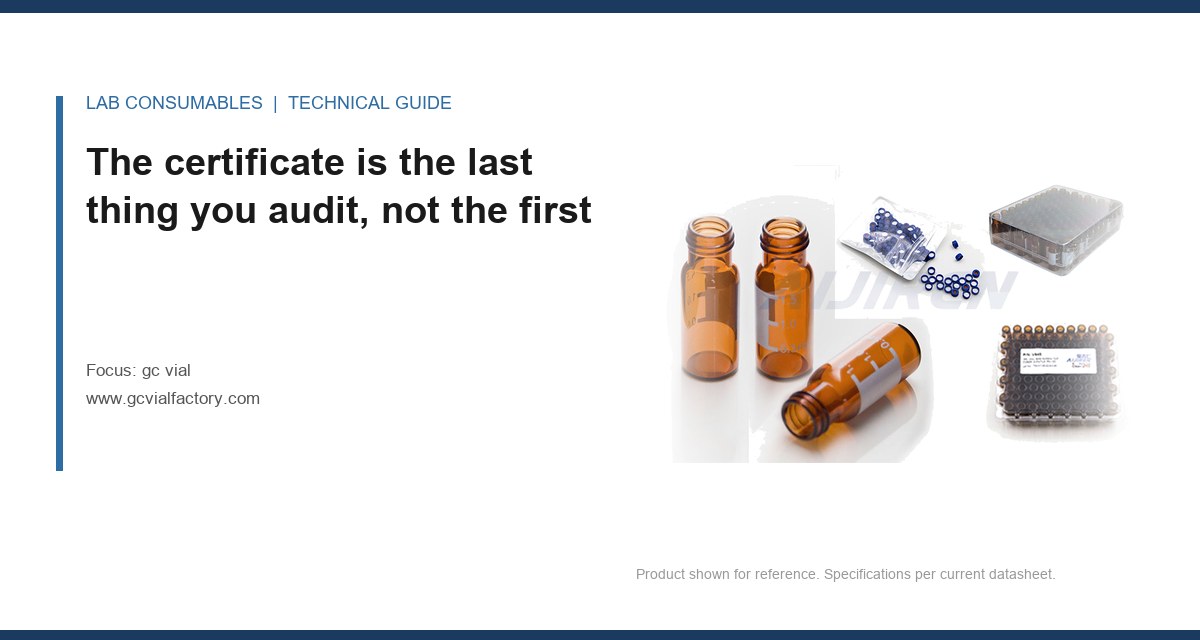
A supplier sent us a lot of 9 mm crimp vials with a certificate showing septum hardness of 48 Shore A and a 2.1 mg extractables figure. We ran the audit checklist anyway, asked for the incoming raw material records, and found the septum batch had been switched from 55 Shore A to 48 Shore A six weeks earlier without a change note. The certificate was accurate for the sample they tested. It was not accurate for the lot we received. That is the whole case for a gc vial supplier audit checklist: the certificate describes a sample, the audit describes the process that produced the sample, and only one of those predicts the next shipment.
What follows is the checklist I use, the evidence I request before the audit call, and a scoring method that produces a number instead of a feeling. It does not cover the factory floor walk-through or contract language; those belong to a different conversation. This is about the quality-system items that predict failure, the documents that expose them, and how to rank vendors objectively.
Most procurement teams start with the CoA because it is the document the vendor sends unasked. That is backwards. A CoA is a snapshot of one sampling event. The items that predict whether the next 50,000 vials behave like the last 50,000 are upstream: resin lot control, mold maintenance, septum batch traceability, and the calibration chain behind the dimensional measurements.
I ask for four document sets before the audit call, and I read them in this order:
- Incoming material records for the last 12 months, covering borosilicate glass tubing, PTFE-faced silicone septum sheet, and caps. I want to see lot numbers, supplier names, and the receiving inspection result for each.
- Mold maintenance log for the vial body and the cap. I want the last 24 months of cavitation repairs, polish cycles, and dimensional re-qualification after each repair.
- Calibration certificates for the dimensional gauges (neck OD, neck ID, height, crimp skirt) with the calibration interval and the reference standard used.
- Change control register for the last 24 months, with customer notification records. This is the document that catches the Shore A swap before it reaches you.
If a vendor cannot produce the change control register within five working days, that alone is a failing score. Everything downstream of it is unverifiable.
Six quality-system items that predict a bad lot before it ships
These are the items I weight most heavily. Each one has a specific failure mode attached to it, and each one is checkable from documents rather than from a tour.
1. Resin and glass lot traceability down to the cavity
Glass tubing from different draws has different thermal history, and that shows up as dimensional drift after the forming step. I want to see that the vendor records which tubing lot went into which production run, and which mold cavities ran in that run. If they can only tell me “we used Schott tubing,” that is a traceability gap. The question to ask: can you pull a finished vial from a customer complaint and name the tubing lot, the mold cavity, and the shift? A vendor with cavity-level traceability can. A vendor without it cannot.
2. Septum batch control and durometer verification
The septum is where most GC vial failures originate, and durometer is the specification that drifts most quietly. A 55 Shore A silicone septum and a 48 Shore A septum both pass a visual inspection and both crimp onto the neck. They do not both hold 1.5 psi for 24 hours under a crimp that was set for the harder material. I ask for the durometer test record per septum batch, the test method (ASTM D2240, typically), and the acceptance window. If the window is wider than ±3 Shore A, the vendor is not controlling the property, they are observing it.
3. Dimensional capability on the three neck dimensions
The neck OD, neck ID, and the crimp skirt height each carry a tolerance, and the process capability behind those tolerances is what separates a good vendor from a lucky one. I ask for Cpk on each dimension from the last 20 production lots. A Cpk of 1.33 is the floor. A Cpk below 1.0 on neck OD means the vendor is sorting good parts out of a drifting process, and sorting always leaks. Ask which gauge they use for neck OD (a go/no-go ring gauge is not a measurement, it is a pass/fail) and whether the gauge is calibrated against a certified reference.
4. Cleanliness protocol with a documented residue limit
For trace analysis, the vial has to arrive clean enough that the method’s detection limit is set by the instrument, not the container. I ask for the cleaning protocol (wash sequence, rinse water resistivity, drying temperature and duration), the residue test method, and the acceptance limit. A vendor that says “we wash them” without a residue figure is not controlling cleanliness. A vendor that reports a residue figure without the test method is publishing a number, not a result. The method matters: a gravimetric residue test and a GC-MS extractables screen measure different things and one does not substitute for the other.
5. Packaging and the transit test record
Vials that leave the factory intact can arrive with micro-cracks at the neck from drop shock. I ask for the packaging specification (tray material, layer count, case drop height rating) and the last transit test record. ISTA 3A or an equivalent protocol is the reference. A vendor that has never run a transit test is trusting the carrier, and the carrier is not on your supplier list.
6. Nonconformance and CAPA trend, not the CAPA count
Every vendor has CAPAs. What matters is whether the same failure mode keeps appearing. I ask for the nonconformance log for 24 months, sorted by defect type, and I look for repeat items. A vendor with 40 CAPAs and no repeats is a functioning quality system. A vendor with 12 CAPAs where 8 are “septum lot variance” is a vendor that has not fixed the root cause. The trend tells you more than the total.
Evidence to request before the audit call
The audit call is expensive in time on both sides. I front-load the document request so the call is about the gaps, not about the basics. Here is the request list I send, with a five-working-day deadline and a note that missing items will be scored as zero rather than as “pending.”
| Item | What it proves | Acceptance threshold | Weight |
|---|---|---|---|
| Change control register, 24 months | Whether material or process changes reach you before they reach your method | Complete, with customer notification records | 20 |
| Septum durometer records per batch | Whether hardness is controlled or merely observed | ASTM D2240, window ±3 Shore A or tighter | 15 |
| Cpk on neck OD, ID, skirt height | Whether the process is capable or sorted | Cpk ≥ 1.33 on all three | 15 |
| Mold maintenance and re-qualification log | Whether dimensional drift after repair is caught | Re-qualification within 5 lots of any repair | 10 |
| Gauge calibration certificates | Whether the measurements mean anything | Traceable to a national standard, interval ≤ 12 months | 10 |
| Cleaning protocol and residue test method | Whether cleanliness is specified or assumed | Method named, limit stated, limit justified for trace work | 10 |
| Nonconformance log, 24 months, by defect type | Whether root causes get fixed | No repeat defect type above 10% of total | 10 |
| Packaging spec and transit test record | Whether arrival condition is controlled | ISTA 3A or equivalent, current within 24 months | 5 |
| Incoming material records, 12 months | Whether upstream lots are traced | Lot-level traceability to finished goods | 5 |
The weights are the ones I use for a GC vial vendor whose product feeds a regulated method. Adjust the weights if your application is less sensitive, but do not drop the change control register from the top of the list. It is the single item that most often explains why a previously good vendor suddenly ships a bad lot.
Scoring a vendor without arguing about it
A checklist that produces a paragraph of impressions is not a scoring tool. I score each item on a 0 to 4 scale against a defined anchor, multiply by the weight, and divide by the maximum possible. The anchors matter more than the weights.
- 4: Documented, current, method named, meets the threshold.
- 3: Documented and meets the threshold, but method is not named or the record is more than 12 months old.
- 2: Documented, but the threshold is not met or the record has a gap.
- 1: Partially documented, or the vendor describes the process verbally but cannot produce the record.
- 0: No record, or the request was not answered within the deadline.
I run the scoring blind: two people score independently, then reconcile any item where the scores differ by more than one point. That reconciliation step is where the real information surfaces, because it forces the vendor’s account manager and quality contact to give the same answer to the same question. When they do not, the gap is usually in the process, not in the communication.
A total below 70 out of 100 is a conditional approval at best, and conditional approval means a first-article inspection on the first three lots plus a retained sample from each. Between 70 and 85 is approved with an annual re-audit. Above 85 is approved with a two-year re-audit cycle. The numbers are not sacred; the discipline of producing one is. A vendor that scores 88 and then fails a lot is a signal to re-score, not a signal that scoring does not work.
If you source through a distributor rather than a factory, score the distributor on the same items but add one: whether they can produce the factory’s records on request, or only their own repackaging records. A distributor who cannot get the factory’s change control register is a distributor who cannot warn you about a material change. For a broader view of where the vial sits in the supply chain, the GC vial reference material is a reasonable starting point, and the same traceability logic applies to the reagent bottle and sample vial lines if you buy those from the same vendor.
Two field cases where the audit caught what the certificate did not
Case one: the durometer swap
The symptom was a slow leak on a crimp-sealed method running at 250 °C inlet temperature. Peak areas drifted down about 4% RSD across a 40-vial sequence, and the drift was not present on a re-run of the same vials. The measurement that identified it was a septum durometer check on retained vials from the suspect lot: 47 to 49 Shore A, against a specification of 55 ± 3. The audit checklist item that should have caught it was the change control register, which showed no entry for the septum supplier change six weeks before the lot shipped. The fix was a supplier corrective action request, a re-qualification run with the correct septum, and a requirement that any durometer change beyond ±2 Shore A triggers customer notification. The vendor’s certificate had been accurate for the sample they tested; the lot had drifted because the incoming inspection was sampling one sheet per pallet instead of one sheet per batch.
Case two: the transit crack
The symptom was a 1.8% reject rate at goods-in, all with hairline cracks at the neck, none visible on the vendor’s outgoing inspection. The measurement was a dye penetrant check on the reject vials, which showed the cracks initiated at the crimp skirt transition. The audit item that explained it was the packaging specification: the vendor had changed from a five-layer tray to a three-layer tray to reduce freight cost, and the change was in the change control register but had not been flagged as a customer-affecting change. The transit test record was 30 months old and predated the tray change. The fix was a return to the five-layer tray, a fresh ISTA 3A transit test, and a rule that packaging changes are customer-affecting by default. The crack was not a molding defect; it was a handling defect that the vendor’s outgoing inspection could not see because the cracks opened in transit, not on the line.
What the checklist will not tell you
An audit checklist scores a process. It does not score the vendor’s willingness to tell you when something goes wrong. That is a separate judgment, and it comes from the reconciliation conversation, not from the documents. A vendor who volunteers a change before you find it in the register is worth more than a vendor who scores 95 and hides the next one. I keep a short note on each vendor’s notification history alongside the score, and I weight it when two vendors are within five points of each other.
I also do not score the certificate. The certificate is evidence that the vendor tested something. The audit is evidence that the something was drawn from a process you can predict. For the analytical side of that distinction, the Agilent chromatography consumables documentation and the Restek technical resources both describe the dimensional and material tolerances that matter, and the Thermo Fisher sample handling material covers the autosampler interface where a marginal vial fails first. The regulatory frame for containers in waste and materials testing sits in U.S. EPA SW-846, and if your method is regulated, the container rules there are the ones your vendor’s records have to satisfy.
Troubleshooting the audit itself
Three things go wrong with supplier audits more often than with the vendors being audited.
- Scoring the sales contact. The person who answers the audit call is often not the person who owns the quality system. Ask for the quality manager by name and score the answers they give, not the ones relayed through the account manager.
- Accepting “we can send that later.” A document that arrives after the deadline is a document that was reconstructed for the audit. Score it as zero and note it. The reconstruction itself is the finding.
- Auditing once and never again. A score is a snapshot. The change control register is the item that moves fastest, and a vendor who passed at 88 two years ago can be at 65 today if the register has gone stale. Re-score annually on the three highest-weight items even if the full audit is on a two-year cycle.
The HPLC autosampler vial side of the same vendor often shares the septum and cap supply chain, so a finding on one product line is worth checking against the other before you close the CAPA.
If your vendor cannot produce a change control register, a septum durometer record per batch, and Cpk on the three neck dimensions within five working days, do not approve them on the strength of the certificate. Approve on the documents, score on the anchors, and re-score the change control register every year. The certificate tells you what left the factory last time. The register tells you what will leave it next time, and that is the number your method actually depends on.
References & further reading
Related resources from our lab consumables network:
- Gc Vial at gcvialfactory.com
- Reagent Bottle at reagentbottleforsale.com
- Hplc Autosampler Vial at hplcautosamplervials.com
- Sample Vial at samplevialprice.com
External references and standards: