
 English
 中文简体
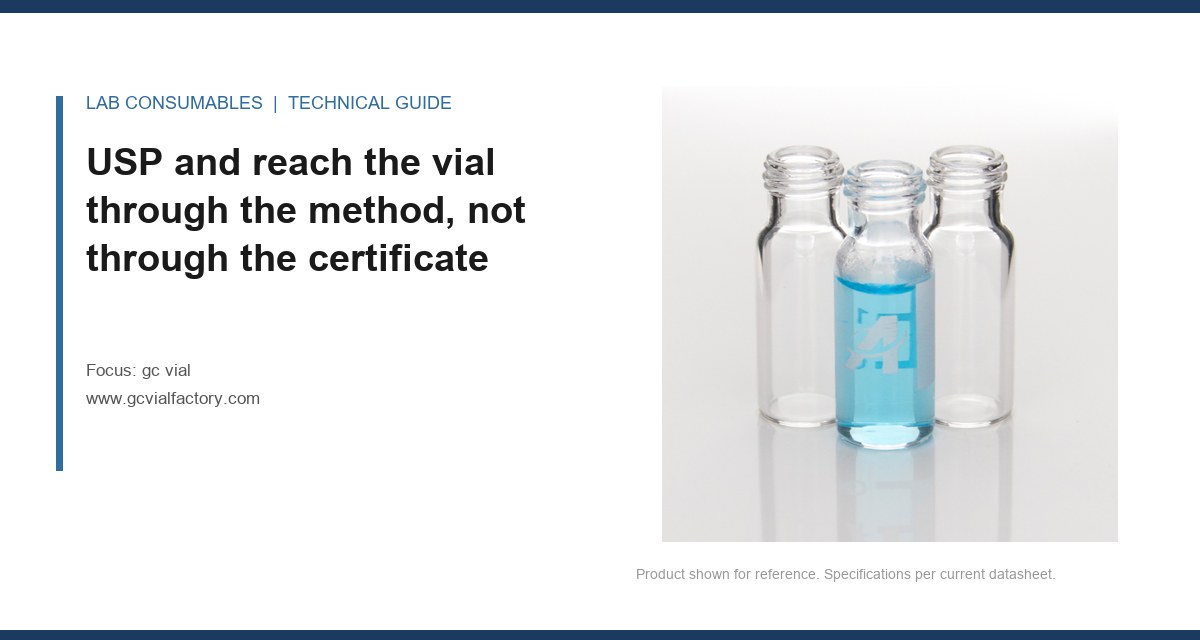
A Monday morning sequence run on a GC-FID system came back with an RSD of 7.8% on the internal standard across 48 injections. The method had been running under 2.0% for eight months. The column was new, the inlet liner was clean, and the calibration standards were freshly prepared. The only change was a new lot of 2 mL, 9 mm crimp-top vials that purchasing had approved based on price. That lot is where USP requirements for gc vial in a validated method stopped being an abstract checklist item and became a deviation investigation.
Most laboratories assume USP says nothing about GC vials because no general chapter is titled “chromatography vials.” That assumption costs time during audits and method transfers. USP <795> Pharmaceutical Compounding – Nonsterile Preparations and USP <621> Chromatography both impose requirements that travel downstream to the consumable. <621> states that system suitability must be demonstrated before and during analysis. That includes injection precision limits, which are normally set at an RSD of no more than 2.0% for replicate injections of a standard solution unless the monograph says otherwise. If a vial lot produces an RSD above that limit, the system fails suitability. The vial is not excused from the measurement because it is a consumable. It is part of the injection system.
<795> matters for any laboratory testing compounded preparations. It requires that analytical methods used to verify potency, sterility, or beyond-use dating be validated and stability-indicating. A validated method includes the sample container. If you qualify a method using one vial type and then switch to a different cap liner or glass formulation, you have changed a variable the validation did not cover. The change may not require full revalidation, but it does require documented equivalency. That is where the lab’s own specification takes over, because USP does not tell you which vial to buy.
USP does not define the vial, so the lab’s specification becomes the enforceable requirement
USP chapters are silent on borosilicate expansion coefficients, septum puncture counts, and cap crimp torque. They do not list acceptable levels for siloxane bleed or specify a minimum PTFE barrier thickness. What USP does require is that the analytical procedure be fit for its intended use and that results be reproducible. Those two requirements force the laboratory to write a vial specification that controls the variables affecting reproducibility. The specification is not optional. During a method transfer or an FDA inspection, the auditor will ask for it. If you cannot produce a written vial specification with acceptance criteria, you have a gap in method validation documentation.
A workable specification for a GC vial in a validated method includes at least these parameters:
- Glass type: Type I, Class A borosilicate (33 expansion) per USP <660> and ASTM E438. Soda-lime glass is not acceptable for trace analysis because sodium and calcium leach into aqueous samples and create ghost peaks.
- Volume and tolerance: 2 mL nominal with a fill volume of 1.5 mL for most autosamplers. A tolerance of ±0.15 mL on the nominal volume is typical. Anything tighter is marketing, not measurement.
- Neck dimensions: 9 mm short thread, 9 mm crimp, or 11 mm crimp depending on the autosampler. The outer diameter tolerance on the neck is ±0.1 mm. A vial that is 0.2 mm undersized will not seat in the tray correctly and will cause needle misalignment.
- Septum material: PTFE/silicone layered, with the PTFE layer facing the sample. The PTFE layer should be at least 45 µm thick. A 25 µm PTFE layer will develop pinholes after 8 to 10 punctures and start leaking volatile analytes.
- Septum hardness: Shore A 45 to 55 for silicone. Harder septa cause needle bending and coring. Softer septa compress under repeated punctures and lose reseal integrity.
- Cap torque for crimp caps: 8 to 10 in-lb for an 11 mm aluminum cap. Below 6 in-lb, the seal leaks. Above 12 in-lb, the cap deforms and the septum extrudes into the vial.
- Residual solvent profile: No peaks greater than 5 pA above baseline at the retention times of your target analytes when a clean vial is heated to 150°C for 30 minutes with the cap on.
That last parameter is the one most labs skip. It is also the one that separates a Gc Vial that works from one that creates a deviation. A vial can pass visual inspection and still bleed enough cyclosiloxane from the septum to coelute with a low-level target compound.
Where USP <621> system suitability meets the physical limits of a consumable
System suitability under <621> typically requires an injection precision RSD of ≤2.0% and a tailing factor between 0.8 and 1.5 for the critical pair. Both numbers assume the injection path is stable. The vial contributes to injection precision in three ways: evaporation through the septum, needle alignment with the vial center, and sample adsorption to the glass surface.
Evaporation is the most common cause of drift in a long sequence. A 2 mL vial with a 9 mm opening and a 1.5 mL fill has a headspace volume of about 0.5 mL. If the septum reseals poorly after each puncture, volatile analytes partition into the headspace and escape. The loss is not uniform across the sequence. The first vial in the tray sits at room temperature for the longest time before injection. The last vial sits for the shortest. That creates a systematic drift in peak area from vial 1 to vial 48. A good septum with a 45 µm PTFE layer and a Shore A 50 silicone core will survive 15 to 20 punctures without measurable loss. A cheap septum will fail after 5.
Needle alignment is a function of the vial neck and the cap. If the cap is crimped off-center, the needle deflects off the aluminum rim and enters the septum at an angle. That tears the septum, creates coring, and changes the injection volume because the needle tip dwell time in the inlet changes. The result is a random RSD that no amount of inlet maintenance will fix. A properly crimped cap sits flat on the vial rim with no visible tilt. The crimp should compress the septum evenly around the full circumference. I check this by running a fingernail around the cap edge. Any gap or raised section means the crimp tool is worn or the cap dimensions are off.
The septum is the only USP-relevant component that degrades during a single sequence
Glass is inert enough for most methods. The cap is aluminum or polypropylene and does not contact the sample. The septum is the interface between the sample and the needle, and it is the only component that changes during the run. USP <621> does not mention septa, but it does require that the system remain suitable for the duration of the analysis. A septum that fails mid-sequence violates that requirement.
Septum failure modes in a validated GC method include:
- Coring: A plug of septum material is punched into the vial or the inlet liner. The plug can block the needle, reduce injection volume, or decompose in the inlet and create ghost peaks.
- Leaching: Low-molecular-weight siloxanes migrate from the silicone core into the sample, especially with nonpolar solvents like hexane or DCM. The leaching increases with temperature and time.
- Adhesion loss: The PTFE layer separates from the silicone core after repeated punctures. The needle then contacts bare silicone, which is sticky and can pull sample out of the needle during withdrawal.
- Compression set: After 10 to 15 punctures, the septum does not return to its original thickness. The cap is now loose, and the headspace pressure changes.
A practical rule for a validated method: set the maximum puncture count per vial at 3 for splitless injection of volatile compounds, 5 for split injection of semivolatiles, and 1 for headspace analysis where the vial is pressurized. Document this in the method. If the autosampler can track punctures per vial, enable that feature. If it cannot, track it manually in the sequence log. This is not over-engineering. It is the difference between a method that passes suitability on Monday and fails on Friday.
What a certificate of analysis must show for a USP-controlled method
Every vial lot should arrive with a certificate of analysis (CoA). For a validated method, the CoA is not a formality. It is evidence that the lot meets the specification you wrote. If the CoA does not list the parameters in your specification, you have not verified the lot. You have accepted the manufacturer’s word for a product they did not test against your method.
A CoA for a GC vial used in a USP-controlled method should include at least the following:
- Glass type and expansion coefficient (e.g., Type I borosilicate, COE 33)
- Neck dimension measured values (OD, ID, height) with tolerances
- Septum construction (PTFE thickness, silicone hardness, total thickness)
- Residual solvent test result for a specified set of solvents
- Particulate count for the vial interior
- Lot number and date of manufacture
If the CoA says “conforms to USP <660>” but does not list the measured expansion coefficient, that is a declaration, not a measurement. I have rejected lots on that basis. A declaration without a number is not traceable. The same applies to septum hardness. “Medical-grade silicone” is not a specification. Shore A 50 with a tolerance of ±5 is a specification.
For laboratories that buy from a distributor, the distributor’s CoA is only as good as the manufacturer’s data behind it. Ask for the underlying lot data. If the distributor cannot provide it, buy from a manufacturer that prints the lot-specific values directly on the CoA. The Reagent Bottle you use to prepare standards has the same traceability requirement. The vial is no different.
Two field cases that only make sense in a USP compliance context
Case 1: RSD drift across a 60-vial sequence. A contract lab running a residual solvents method per USP <467> saw the internal standard area drop 14% from vial 1 to vial 60. The RSD for the first 10 injections was 1.4%. For the last 10, it was 4.9%. The lab replaced the inlet liner, the gold seal, and the syringe. No change. The measurement that identified the problem was a headspace pressure check on 10 capped vials that had been punctured 5 times each. The pressure loss was 22% compared to unpunctured vials from the same lot. The septum was a 25 µm PTFE over silicone, and the PTFE layer had developed pinholes after 3 punctures. The fix was to switch to a 50 µm PTFE septum and set the maximum puncture count at 3. The RSD returned to 1.8% across the full sequence on the next run.
Case 2: A ghost peak at the retention time of a low-level impurity. A pharmaceutical QC lab running a GC method for a volatile impurity at 0.05% saw a peak at the impurity retention time in the blank. The peak area was equivalent to 0.03% of the active peak. The lab assumed column carryover and baked the column for 4 hours. The peak remained. The measurement that identified the source was a direct injection of a clean vial that had been capped and heated to 80°C for 1 hour. The same peak appeared. The septum lot was a silicone-only formulation without a PTFE barrier. The silicone was bleeding a low-molecular-weight siloxane that coeluted with the impurity. The fix was to switch to a PTFE/silicone septum with a 45 µm PTFE layer and to add a septum blank check to the method’s system suitability protocol. The ghost peak disappeared, and the blank stayed clean for the next 6 months.
Decision checklist: does your current vial lot meet the USP-driven specification?
Run this checklist before you qualify a new vial lot into a validated method. If any answer is no, the lot fails the specification and should not be used.
| Parameter | Acceptance criterion | Test method |
|---|---|---|
| Glass type | Type I, Class A borosilicate, COE 33 | CoA or in-house density test |
| Neck OD | 9.00 ± 0.10 mm for 9 mm crimp | Caliper, 10 vials per lot |
| Septum PTFE thickness | ≥ 45 µm | Cross-section microscopy, 3 septa per lot |
| Septum hardness | Shore A 45 to 55 | Durometer, 5 septa per lot |
| Puncture reseal | No pressure loss after 5 punctures | Headspace pressure test, 5 vials per lot |
| Residual solvent bleed | No peak > 5 pA at target RTs | Blank vial run at method temperature |
| Cap crimp torque | 8 to 10 in-lb for 11 mm Al cap | Torque wrench on crimper |
This table is not from USP. It is the lab’s own specification, written to satisfy USP’s requirement that the method be reproducible. USP provides the obligation. The lab provides the numbers.
What USP leaves open, and what that means for purchasing decisions
USP does not tell you to buy a specific vial brand. It does not specify a septum formulation or a cap material. It requires that the analytical procedure produce accurate, reproducible results. That requirement is met or violated at the level of the consumable. A purchasing decision based on unit price alone will eventually create a deviation. The cost of that deviation, in analyst time, investigation hours, and lost production, exceeds the savings on the vial lot by a factor of 10 to 50.
The practical approach is to qualify two vial suppliers, not one. Qualify both against the same specification. Then you have a backup when a lot fails or a supplier has a backorder. The qualification data from the first supplier is not transferable to the second. Each lot from each supplier gets its own CoA review and, if the method is high-risk, its own blank injection check.
For methods that run at high inlet temperatures, above 250°C, the septum choice matters more than the glass. A silicone-only septum will start to degrade at 200°C. A PTFE/silicone septum is rated to 250°C. For inlet temperatures above 300°C, use a septum with a higher-temperature core, such as a fluoroelastomer or a high-temperature silicone blend. Check the manufacturer’s temperature rating on the CoA. If the CoA does not list a temperature rating, assume 200°C maximum and do not use it above that.
For trace-level work below 1 ppm, the vial interior surface matters. Untreated borosilicate glass has silanol groups that can adsorb polar analytes like amines and alcohols. A silanized vial reduces that adsorption. The silanization is a chemical treatment, not a coating. It should be specified as “silanized per USP <660>” and verified by a contact angle test or a recovery test with a polar probe compound. A silanized Sample Vial costs more, but the alternative is a method that fails linearity at the low end.
The same logic applies to the Hplc Autosampler Vial in a USP <621> HPLC method. The consumable is part of the injection system. The chapter does not name it, but the reproducibility requirement reaches it. If you run both GC and HPLC methods, your vial specification should cover both, with separate criteria for the different injection mechanisms.
External resources that help here: Agilent publishes application notes on vial selection for specific GC methods, Restek maintains a technical library on septum materials and bleed profiles, and Thermo Fisher documents the interaction between vial geometry and autosampler performance. For environmental methods that run under U.S. EPA SW-846, the same vial specification applies, because the method detection limit depends on the same injection precision.
The decision rule is simple. Write a vial specification with measurable acceptance criteria. Review every CoA against that specification. Qualify two suppliers. Set a maximum puncture count. Run a blank vial check at the start of any sequence longer than 20 injections. If a lot fails any criterion, reject it and document the rejection. That is what USP compliance looks like at the level of a 2 mL glass tube with a 9 mm cap. It is not the chapter that fails. It is the lab that skipped the specification.
References & further reading
Related resources from our lab consumables network:
- Gc Vial at gcvialfactory.com
- Reagent Bottle at reagentbottleforsale.com
- Hplc Autosampler Vial at hplcautosamplervials.com
- Sample Vial at samplevialprice.com
External references and standards: