
 English
 中文简体
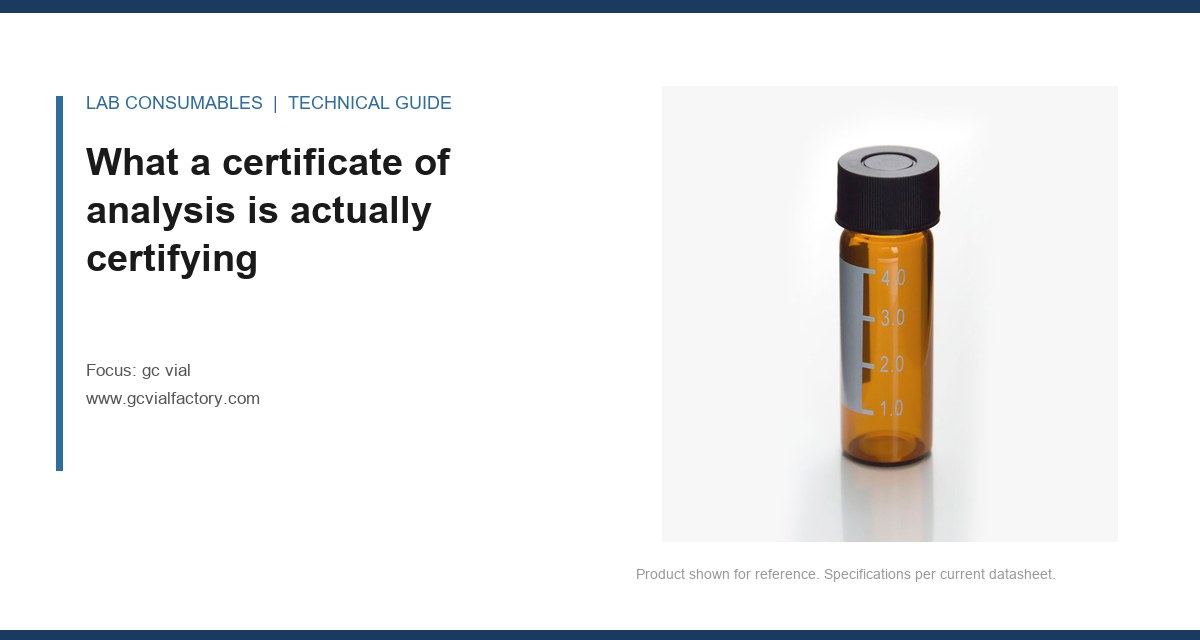
I have read more than a thousand GC vial certificates of analysis, and the same thing happens almost every time: the buyer scans the top line, sees “9 mm screw thread, 2 mL, 100/pk” and files it. Then three months later a batch of blanks shows siloxane peaks at m/z 73 and 207 and nobody connects the dots back to the one document that would have told them. I have been on both sides of that document, as the person writing it in the factory and the person relying on it in the lab, and I can tell you that most of the useful information sits in the middle, not the top. This guide walks through a typical certificate line by line and tells you what to check, what to ignore, and where a real specification ends and marketing begins.
A certificate of analysis is not a product datasheet. A datasheet tells you what the manufacturer intends to make. A certificate tells you what they measured on the lot in front of you, and against which limits. Those are different claims, and the difference is where procurement problems breed.
I have seen suppliers send a “certificate” that is really a reprint of the catalogue page with a lot number typed at the top. No test methods, no measured values, no specification limits, no signature. If you cannot tell from the document what was tested on that specific lot, you do not have a certificate. You have a label with extra steps.
A legitimate certificate for a GC vial should carry four things for every parameter: the specification limit, the test method used, the measured result for the lot, and a pass/fail disposition. If any one is missing, the line is decoration. The rest of this article is about reading those four columns against what your method actually needs.
The header block: identity, not quality
The top of the certificate has the manufacturer name, part number, lot number, manufacture date, and quantity. All of that is identity. None of it is a quality claim. It matters for traceability and for matching the certificate to the box in the storeroom, and that is the entire job of the header.
Two things to actually check here. First, the lot number on the certificate must match the lot number on every carton in the shipment. I have seen split shipments where half the boxes carried a different lot than the paperwork. Second, the manufacture date is not the same as the expiration date, and a certificate without an expiry or retest date is telling you something about how the manufacturer thinks about shelf life. If they will not commit to one, you get to guess.
Some certificates also list the raw material lot numbers for resin, septum compound, and cap lining. That is a good sign. It means the factory can trace a finished vial back to a pellet of resin, which is exactly what you need when a contamination event forces a root cause investigation.
Dimensional section: the tolerances that actually matter
This is the section most buyers skip and the section that causes the most autosampler faults. A 2 mL GC vial on a 9 mm screw thread has a defined neck finish. The certificate should list the key dimensions with limits and measured values. Here is what to look for and the numbers I would accept.
Critical dimensions on a 9 mm screw-thread vial
- Body outside diameter: typically 11.6 mm nominal with a limit around ±0.2 mm. Too large and the vial binds in a 32-position tray. Too small and the gripper misses.
- Height: typically 32 mm for a 2 mL vial, limit ±0.3 mm. Height drift is what makes the needle depth inconsistent across a tray.
- Neck finish thread: the certificate should reference the 9 mm screw-thread standard the closure is designed to, usually a GPI 9 mm or an equivalent defined in the drawing. If the certificate has no thread callout, ask for the drawing.
- Sealing surface flatness: this is the one nobody lists and everybody should. The annulus that the septum seats against has to be flat within a few thousandths of an inch or the closure cannot seal regardless of torque.
- Bottom concentricity: matters for any autosampler that centres the vial by the base.
If the certificate lists only “OD” and “height” with no limits, you have a marketing document. Real certificates show the tolerance band. A ±0.2 mm band on a moulded part is achievable and normal. If a supplier claims ±0.05 mm on an injection-moulded vial, ask which dimension and be skeptical, because that is machined-part territory and no moulded vial holds it across a full lot at commodity pricing.
Why the neck dimension is the one to argue about
The neck finish controls two things at once: whether the cap seals and whether the autosampler needle guide lines up. A neck that is 0.3 mm off centre will pass a visual check and fail a run. I have watched a tray of vials where the needle guide contacted the cap on roughly one vial in forty because the neck sat slightly outboard. The autosampler logged it as a needle error, and the lab blamed the syringe. The certificate would have shown the runout if anyone had asked for it.
Ask for neck concentricity or runout on the certificate. If the supplier cannot measure it, that tells you what their process control actually covers.
Material section: resin grade and what the certificate can and cannot prove
The material line usually reads something like “borosilicate glass 3.3, USP Type I” or “polypropylene, virgin, no recycled content.” Both claims are worth having, and both are only as good as the test behind them.
For glass vials, the certificate should name the glass type and reference a hydrolytic resistance test. USP Type I borosilicate is the standard for GC work because it resists leaching under acidic sample conditions and does not shed alkali the way Type III soda-lime does. The certificate should show the test method (typically a hydrolytic resistance titration per USP or an equivalent) and a result. If it just says “Type I” with no test, you are trusting a label.
For plastic vials and for the cap, the certificate should state virgin resin and, ideally, the resin manufacturer and grade. Recycled content is the thing to watch. Regrind in a polypropylene vial is not automatically bad, but it is unpredictable, and unpredictable is exactly what you do not want in a component that sits inside your method. If the certificate is silent on recycled content, assume there is some.
One caveat that matters for procurement: a certificate can tell you the resin grade. It cannot tell you the moulding conditions, and moulding conditions are what drive residual volatiles. That is why the next section exists.
The volatile and extractable section: the part that decides your baseline
This is where a good certificate earns its keep. A GC vial that is clean on dimensions and dirty on volatiles will ruin your chromatogram. The certificate should list a volatiles or extractable test with a method, a limit, and a result.
What a usable volatiles test looks like
The common approach is a headspace GC-MS screen of a batch of vials against a blank. The certificate should tell you the sample preparation (how many vials, what volume, what temperature, how long), the instrument conditions, and the acceptance criteria. A typical criterion is no individual siloxane or hydrocarbon peak above a defined area threshold, and no total volatile response above a second threshold.
Read the numbers, not the pass stamp. A certificate that says “passes volatiles” with no method is worthless. A certificate that says “HS-GC-MS at 120 °C for 30 min, no peak above 5% of the internal standard area” gives you something you can compare across lots and across suppliers.
Two practical checks I make. First, does the test temperature match your method? If your autosampler runs headspace at 150 °C and the certificate tested at 80 °C, the certificate is not telling you what you need to know. Second, does the certificate name the target compounds? Siloxanes from septum bleed, hydrocarbons from mould release, and plasticizers from packaging are different failure modes with different fixes. A certificate that lumps them into “total volatiles” hides which one you are dealing with.
Septum and cap contributions
The septum is the usual suspect for siloxane background, and the certificate for the assembled vial should either test the closure in place or carry a separate septum certificate. If it does neither, you are buying a vial whose most contamination-prone component is undocumented. I have written about septum design elsewhere on this site, but the certificate point is simple: the assembled vial’s volatiles result should reflect the assembled vial, septum included, not a bare glass body.
For the cap lining, look for a statement on the liner material and a note on whether it is bonded or loose. A loose PTFE-faced silicone liner can shift during capping and produce a leak the certificate will never show, because the certificate tests the components, not the capping torque. That is a process control issue, and it belongs in the next section.
Closure and torque section: the number most certificates omit
A surprising number of certificates list the cap and septum dimensions but say nothing about the capping torque used to assemble them. That is a gap, because torque is the single biggest driver of both leaks and septum damage, and it is entirely within the manufacturer’s control.
For a 9 mm screw-thread GC vial with a silicone/PTFE septum, the capping torque window I work to is roughly 0.5 to 0.9 N·m, with the target set by the closure design and the septum durometer. Under-torque and you get leaks and evaporation over a long sequence. Over-torque and you cold-flow the septum, which shows up later as coring, needle damage, and a wandering baseline. A certificate that names the torque target and the measured range is a certificate from a factory that understands the failure mode.
If torque is not on the certificate, ask for it. If the supplier cannot produce it, ask how they control capping. The answer will tell you more about the factory than the rest of the document.
Physical and functional tests: puncture, seal, and visual
The functional section covers the tests that simulate what the autosampler will do to the vial. These are the lines I read most carefully, because they are the closest thing on the certificate to a real-world prediction.
Septum puncture count
A silicone/PTFE septum on a 9 mm GC vial should survive a defined number of punctures before coring or leakage. The certificate should state the test method (needle gauge, puncture rate, reseal time) and the acceptance criterion. A common criterion is no leakage after 10 punctures with a 23-gauge needle, though some methods push to higher counts. Read the needle gauge. A puncture test done with a 26-gauge needle tells you almost nothing about what a 21-gauge needle will do.
Seal integrity and evaporation
This is usually a gravimetric test: fill, cap, weigh, hold at a defined temperature and time, reweigh, and compare mass loss against a limit. A typical limit for a 2 mL vial might be under 1% mass loss over 24 hours at ambient, or a tighter figure for a headspace method. The certificate should state the fill volume, the temperature, the hold time, and the limit. Without all four, the number is meaningless.
I have seen certificates claim “zero leakage” with no test detail. Zero is not a measurement. A real certificate gives you a limit and a result, and a good one gives you the distribution, not just the worst case.
Visual inspection criteria
The visual line should define what counts as a defect: chips, cracks, foreign matter, dimensional flash, and (for glass) visible stones or seeds. The certificate should state the inspection standard and the AQL or sampling plan. A certificate that says “100% visually inspected” without an AQL is telling you they looked, not that they found anything. Ask for the AQL. If they cannot state one, the inspection is a vibe.
Traceability and lot linkage: the line that saves you in an investigation
The traceability section ties the finished lot back to raw materials and forward to the shipment. For a GC vial, that means resin lot, septum compound lot, cap lot, and the assembly date. It also means the certificate should be uniquely identified (a certificate number or revision) and signed or authorised.
Why does this matter to a procurement manager? Because when a contamination event hits, the first question is “which lots are affected,” and the answer has to come from the certificate. If the certificate cannot link a finished lot to a raw material lot, you cannot scope the recall, and you end up quarantining everything. I have seen a lab throw out six months of vials because the paperwork could not narrow the suspect lot to one shipment.
Also check the revision. Certificates get reissued when a specification changes. If the certificate revision on file does not match the revision on the shipment, you are comparing apples to a different apple. Keep the revision number in your supplier records.
A line-by-line decision checklist with concrete numbers
Here is the checklist I use when qualifying a new GC vial supplier. It is deliberately blunt. Each line has a pass criterion and a fail criterion, and the fail criterion is what I actually act on.
| Certificate line | Pass looks like | Fail / ask again |
|---|---|---|
| Lot number match | Matches every carton, with raw material lots listed | Certificate lot differs from carton, or no raw material traceability |
| Body OD | 11.6 mm ±0.2 mm with measured value | Nominal only, no tolerance |
| Height | 32 mm ±0.3 mm with measured value | No limit, or limit wider than ±0.5 mm |
| Neck concentricity | Stated runout limit with measured value | Not listed |
| Glass type | USP Type I borosilicate with hydrolytic resistance result | “Type I” with no test |
| Resin grade (plastic) | Virgin, named grade, no regrind statement | Silent on recycled content |
| Volatiles test | HS-GC-MS, method conditions, target compounds, limit, result | “Passes” with no method |
| Septum puncture | ≥10 punctures, 23-gauge needle, leakage criterion | Count without needle gauge |
| Seal / evaporation | Gravimetric, fill volume, temp, time, limit, result | “Zero leakage” |
| Capping torque | Target 0.5–0.9 N·m with measured range | Not listed |
| Visual AQL | Defined AQL and sampling plan | “100% inspected” only |
| Traceability | Raw material lots, assembly date, certificate revision, signature | No revision or no signature |
If a supplier passes ten of twelve lines and fails on torque and volatiles method, that is not a marginal supplier. That is a supplier who has not thought about the two failure modes that matter most. I would walk.
Reading the certificate against your method, not in isolation
A certificate is only useful relative to your method. A vial that passes every line on the certificate can still be wrong for your application. Three examples I have run into.
First, temperature. If your method runs headspace at 150 °C, a septum certified to 120 °C is out of scope no matter how good the rest of the document is. The certificate should state the septum’s rated temperature, and you should match it to your method with margin. A 20 °C margin is not excessive.
Second, sample chemistry. A borosilicate vial is fine for most aqueous and organic samples. If your sample contains a strong base or a chelating agent, glass surface chemistry matters more, and the certificate’s hydrolytic resistance line becomes the one you care about. If it is not there, ask.
Third, autosampler geometry. A certificate can tell you the vial is in spec. It cannot tell you whether your autosampler’s gripper likes the cap profile. That is a fit trial, and no certificate replaces it. But a certificate with tight neck runout and height limits is a much better starting point for a fit trial than one without.
For cross-reference, the instrument manufacturers publish consumable compatibility tables, and those are worth reading alongside the certificate. Agilent’s chromatography consumables and columns documentation and Thermo Fisher’s chromatography and sample handling resources both list vial dimensions and autosampler compatibility, and they are a useful sanity check on the certificate’s dimensional claims. Restek’s technical resources are good for septa and liner selection. None of these replaces the certificate, but they help you ask better questions.
Where suppliers game the certificate
I will name the tricks because I have seen them used.
Testing a golden sample. The certificate reports a result from a hand-picked vial, not a lot sample. The tell is the sample size. A volatiles test on three vials is not a lot test. Ask how many units were sampled and whether the sample was randomised from the lot.
Widening the limit after the fact. The measured value is real, but the specification limit was set to whatever the lot happened to produce. The tell is a limit that exactly matches the result. A limit should be set by the method requirement, not by what came off the line.
Method laundering. The test method is named but the conditions are vague. “Per internal method” is not a method. Ask for the internal method number and the key conditions. A supplier who will not share conditions is a supplier who does not want you to compare lots.
Certificate reuse. The same certificate covers multiple lots because “the specification did not change.” That is fine for a datasheet and not fine for a certificate. Each lot should have its own measured values.
None of these are exotic. They are the normal shortcuts of a factory that has not invested in lot testing. The certificate is where they show up.
Troubleshooting: when the certificate passes but the run fails
Sometimes the certificate is clean and the chromatogram is not. Here is the sequence I work through, in order, because the certificate narrows the search.
- Baseline drift or siloxane peaks: check the septum volatiles line first. If the certificate tested at a lower temperature than your method, the septum is the suspect. Replace with a septum rated 20 °C above your method temperature.
- Leaks and evaporation over a long sequence: check the capping torque line and the seal test. If torque is not on the certificate, that is your answer. Re-cap a test batch at 0.6–0.8 N·m and rerun.
- Needle errors and bent needles: check neck concentricity and height limits. If the certificate has no runout line, request it. A tray with one bad vial in forty is a dimensional problem, not a syringe problem.
- Coring and septum fragments in the vial: check puncture count and needle gauge. A puncture test done with a 26-gauge needle does not predict a 21-gauge needle. Ask for the gauge used.
- Carryover that will not clear: check the visual and foreign matter lines. A vial with mould flash or a rough sealing surface can trap sample. The certificate’s AQL tells you how often that slipped through.
- Lot-to-lot variation in blanks: compare the volatiles measured values across lots. If the certificate only has a pass stamp, you have no comparison to make. That is the argument for measured values over dispositions.
If you work through that list and the certificate is clean on every line, the problem is probably upstream of the vial. Check the inlet, the liner, and the syringe. But start with the certificate, because it is the cheapest thing to read.
What to ask for before you place the next order
Three requests, in this order.
First, ask for a full certificate from the last three lots, with measured values and methods, not just dispositions. Read the volatiles and torque lines first. If they are missing, you have your answer about the supplier.
Second, ask for the internal test method numbers and the key conditions for volatiles, puncture, and seal. A supplier who shares conditions is a supplier who expects to be compared.
Third, ask for the raw material traceability for one lot, end to end. If they can walk you from a finished vial to a resin lot and a septum compound lot, the certificate is real. If they cannot, the certificate is a document, not a control.
The same discipline applies to the rest of your consumable stack. A HPLC autosampler vial certificate should be read the same way, and the dimensional and volatiles logic carries over. When you buy sample vials in bulk, the certificate is your only lot-level evidence, so treat it as a specification, not a receipt. And if your workflow includes solvent and standard storage, the same line-by-line reading applies to a reagent bottle certificate, where the extractable and hydrolytic resistance lines matter just as much.
One regulatory note: if your method is written under EPA SW-846, the SW-846 test methods define the quality control expectations that your consumable documentation feeds into. The certificate is part of how you demonstrate that the vial did not contribute to the result. Keep it with the run records.
Takeaway
Read the certificate from the middle out. The header is identity, the material line is a claim, and the volatiles, torque, puncture, and traceability lines are the ones that decide whether the vial belongs in your method. Demand measured values with limits and methods, not pass stamps. Match the test conditions to your method temperature and needle gauge, because a certificate tested at the wrong conditions is a certificate for a different product. And keep the revision number with your supplier records, because the day a contamination event forces a lot investigation, that document is the only thing that will let you scope the problem to one shipment instead of six months of inventory.
References & further reading
Related resources from our lab consumables network:
- Gc Vial at gcvialfactory.com
- Reagent Bottle at reagentbottleforsale.com
- Hplc Autosampler Vial at hplcautosamplervials.com
- Sample Vial at samplevialprice.com
External references and standards: