
 English
 中文简体
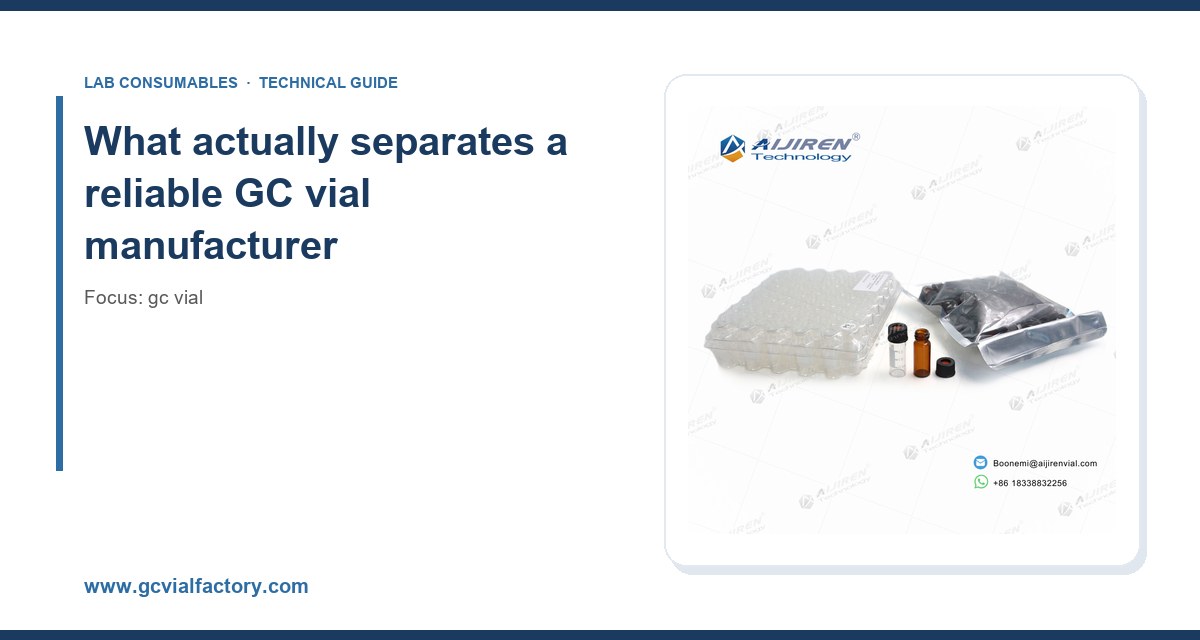
I have rejected more GC vial lots than I care to count, and almost none of them failed on obvious grounds. The glass looked fine, the caps threaded on, the certificate said “GC certified.” Then the septum coring showed up at injection 40 instead of the promised 100, or a batch of 2 mL vials came in at 11.72 mm OD and started jamming in a tray. After fifteen years of running consumables sourcing, I judge a GC vial manufacturer on four things: incoming material control, dimensional discipline, the actual QC data behind the certificate, and whether they can hold a drawing across an OEM run. Marketing copy tells you nothing. Here is what I check, with the numbers I use.
A GC vial is a three-part assembly pretending to be one product. You have the borosilicate body, the closure (open-top or closed-top cap), and the septum bonded into it. Each part has its own failure modes, and a manufacturer that is strong on glass but weak on elastomer compounding will still ship you a bad vial. The good ones control all three in-house or audit the subcontractors at the raw material level, not the finished-goods level.
The practical test is this: can the manufacturer tell you the glass lot, the septum compound batch, and the cap resin grade for a specific shipment, and show you the incoming inspection record for each? If the answer is “we buy finished vials from a trading company,” you are one quality layer removed from the process. That is not automatically disqualifying for routine work, but it changes how much incoming QC you have to do yourself. For anyone buying GC vial stock at volume, the difference between a converter and a reseller is the difference between a corrective action and a shrug.
Materials: the specs that matter and the ones that don’t
Glass: USP Type I borosilicate is the floor, not the ceiling
Every credible GC vial is USP Type I borosilicate, typically borosilicate 3.3 (expansion coefficient around 3.3 x 10^-6 per degree C). That is table stakes. What separates manufacturers is how they handle the surface chemistry and the forming tolerances.
Inertness matters more in GC than most people assume. Underivatized silanol groups on the interior wall will adsorb polar analytes, and you see it as tailing peaks and poor recovery on compounds like phenols, amines, and certain pesticides at low concentrations. Good manufacturers deactivate the interior surface, usually through a silanization or a controlled thermal treatment, and they can tell you which. Ask for a recovery study: a 1 ppm solution of a polar analyte, five consecutive injections from the same vial, and the recovery relative to a fresh standard. I want to see recovery above 95 percent and RSD under 2 percent across the set. If the manufacturer cannot produce that data, assume no deactivation.
Forming tolerances are the other half. For a standard 2 mL, 12 x 32 mm vial, I expect:
- Outer diameter: 12.00 mm plus or minus 0.15 mm. Anything drifting past 12.2 mm starts to bind in autosampler trays and grippers.
- Height: 32.00 mm plus or minus 0.30 mm. Height variation is what causes needle depth errors and, in the worst case, bent syringes.
- Neck finish: 8-425 screw thread (GPI 8-425) for 8 mm closures, or 13-425 (GPI 13-425) for 13 mm closures on 4 mL vials. The GPI designation is the Glass Packaging Institute thread standard; a manufacturer that cannot name the GPI finish on its drawing is guessing.
- Bottom: flat within 0.10 mm so the vial sits square in the tray and the needle does not scrape the floor.
Those are the numbers I put in a purchase specification. A manufacturer that quotes them back to you without argument has done this before.
Septum: the part that fails first
Septum choice drives your puncture count, your coring risk, and your temperature ceiling. There is no universal best septum, only the right one for the injection count and the inlet temperature.
- Silicone with PTFE facing (one side): the workhorse for split/splitless injection. Good reseal, low cost, rated to about 200 degrees C continuous. Puncture count in the 50 to 100 range before coring risk climbs. The PTFE face protects the sample from the silicone and stops the needle from dragging silicone into the inlet.
- Silicone with PTFE on both sides: better chemical resistance to the sample, slightly worse reseal because the needle passes through two PTFE films. Use it for aggressive solvents.
- Molded silicone with a bonded PTFE layer: the higher tier. Consistent thickness, better reseal, puncture counts of 100 to 150 with less coring. This is what I specify for high-throughput sequences.
- Buna-N or butyl: rarely right for GC. Butyl is for headspace and even there it is being displaced. If a supplier pushes butyl for a split/splitless method, they do not understand your application.
Two specs matter as much as the compound: septum thickness (typically 1.0 mm for 8 mm closures, 1.5 mm for 13 mm) and hardness (Shore A 45 to 55 for silicone). A soft septum reseals well but cores easily; a hard one resists coring but leaks. The bonded-layer septa let you run slightly harder compounds because the PTFE carries the reseal.
Ask for a coring test: 100 punctures with a 23-gauge needle, then count visible fragments in the vial and check for inlet liner contamination. A good molded septum shows fewer than five fragments at 100 punctures. A cheap die-cut septum can shed twenty or more by puncture 60, and those fragments end up on your column.
Caps: resin and torque
Most 8 mm screw caps are polypropylene. The grade matters less than the molding consistency. A cap with a short thread or a warped skirt will cross-thread, and a cross-threaded cap is a leak and a lost injection. I check two things: thread engagement (the cap should seat in about 1.5 turns and lock without force) and the applied torque on the capper. For 8 mm closures I run 8 to 12 inch-ounces (roughly 0.9 to 1.35 N·m). For 13 mm closures, 12 to 18 inch-ounces. Over-torque deforms the septum and creates a leak path; under-torque lets the cap back off during a 12-hour sequence. If you hand-crimp, get a torque wrench and verify it monthly.
For headspace work, the cap and septum are usually a crimp style (20 mm aluminum crimp, GPI 20-400 finish) with a butyl or silicone/PTFE septum rated to 250 degrees C for the butyl. Crimp consistency is its own skill; a bad crimp is the number one cause of headspace leaks I have seen.
Quality control: what a certificate of analysis should actually contain
Anyone can print a certificate. The question is what data is behind it. Here is the QC stack I expect from a manufacturer that takes GC seriously, in the order I would audit it.
Incoming material inspection
Glass tubing or molded blanks come in with a dimensional and visual check. Septum sheet stock comes in with a durometer reading and a thickness check. Cap resin comes in with a melt flow index verification. If the manufacturer cannot show you incoming records, the certificate is a marketing document.
In-process dimensional checks
Sampling plan matters. I want to see at least AQL 1.0 or tighter on critical dimensions (OD, height, neck finish) with a documented sample size per lot. A lot of 10,000 vials sampled at 32 pieces is defensible; a lot sampled at 5 pieces is not. The measurement equipment should be calibrated and the calibration traceable to a national standard.
Functional testing
This is where the weak manufacturers get exposed. A real QC program runs:
- Leak test: fill, cap, pressurize or vacuum, and check for loss over a defined interval. For headspace, a pressure decay test on a sample of crimped vials.
- Septum coring: the 100-puncture test described above, on a sample per septum lot.
- Extractables: a solvent extraction followed by GC-MS or LC-MS to confirm no interfering peaks. This is the test that catches a bad deactivation batch before it reaches your method.
- Autosampler compatibility: a run on the actual autosampler model the customer uses. Vials that pass dimensional checks can still fail in a specific gripper.
If you run EPA methods under SW-846, the extractables test is not optional. Method blanks have to be clean, and a vial that leaches plasticizer or siloxane will show up in your blank and in your quantitation. The same logic applies to any regulated method, and the Restek technical resources library has good background on what those interferences look like on a chromatogram.
Traceability and lot control
Every shipment should come with a lot number that ties back to the glass lot, the septum batch, and the cap batch. When a customer reports a problem, the manufacturer should be able to pull the QC records for that lot within a day. If they cannot, you are relying on hope.
OEM capability: the real differentiator
OEM is where a manufacturer’s discipline gets tested. A catalog vial can be “close enough.” An OEM vial has to match a drawing, a color, a label position, and a packaging format, lot after lot, for years. Plenty of manufacturers can make a good first article. Fewer can make the 50th production run identical to the first.
Tooling and drawing control
The manufacturer needs its own molds or a controlled mold relationship, and a drawing control process that versions the drawing and locks it to the production run. Ask to see the drawing revision history for a product they already make for another customer (redacted is fine). If revisions are verbal or tracked in email, walk away.
Custom dimensions and formats
OEM demand usually falls into a few buckets:
- Non-standard heights and diameters for a specific autosampler tray.
- Custom neck finishes for a proprietary closure, though most OEM work stays on GPI standard finishes because the autosampler is designed around them.
- Label and print: graduated markings, lot codes, customer branding. Print position tolerance of plus or minus 0.5 mm is achievable and should be specified.
- Packaging: 100-count trays, 1000-count cases, cleanroom bagging, individual shrink. Packaging is where OEM projects quietly fail because the manufacturer treats it as an afterthought.
Change control
This is the single most important OEM capability and the one most often missing. A manufacturer that switches septum compound suppliers without notifying you has broken your method validation. I require a written change control clause: any change to glass source, septum compound, cap resin, or molding tool triggers a notification and, for regulated customers, a re-qualification. No exceptions.
Capacity and lead time
Ask for the production rate and the minimum order quantity for a custom run. A real converter can turn a custom 2 mL vial in the 50,000 to 100,000 piece range with a 6 to 10 week lead time depending on tooling. If the MOQ is 500,000 for a simple dimensional change, they are not set up for OEM; they are set up for their own catalog.
Comparison checklist: catalog supplier vs. converter vs. OEM partner
I use this table when evaluating a new source. Score each line, and be honest about the middle column.
- Glass spec: catalog reseller gives “borosilicate” with no grade; converter gives USP Type I 3.3 with a lot certificate; OEM partner gives the same plus the tubing source and a deactivation record.
- Dimensional tolerance: reseller quotes a range; converter quotes plus or minus 0.15 mm OD and 0.30 mm height; OEM partner quotes those plus a capability study (Cpk above 1.33 on critical dimensions).
- Septum data: reseller gives a compound name; converter gives durometer and thickness; OEM partner gives durometer, thickness, coring test data at 100 punctures, and temperature rating.
- Certificate of analysis: reseller gives a generic sheet; converter gives lot-specific dimensional and functional data; OEM partner gives the full stack including extractables.
- Change control: reseller has none; converter notifies informally; OEM partner has a written clause with re-qualification.
- MOQ for custom work: reseller does not do custom; converter starts at 100,000; OEM partner starts at 50,000 with tooling amortized.
- Lead time: reseller ships from stock; converter 4 to 6 weeks; OEM partner 6 to 10 weeks with a committed schedule.
Most labs do not need the OEM column for routine work. But if you are running a validated method, or you are the one supplying vials into someone else’s validated method, the middle column is the minimum.
Where the failures actually happen: a troubleshooting checklist
When a customer reports a problem, I run this list in order. It catches about 90 percent of vial-related issues.
- Peak tailing or low recovery on polar analytes: suspect interior deactivation. Run a fresh-lot comparison with a known standard. If the new lot tails and the old one does not, it is the glass surface.
- Ghost peaks or rising baseline: suspect septum bleed or extractables. Swap to a PTFE-faced septum and run a blank. If the peaks disappear, it was the septum. Check inlet temperature against the septum rating; running a 200 degrees C septum at 250 degrees C is a common mistake.
- Coring fragments on the column or in the liner: suspect septum hardness and needle gauge. A 23-gauge needle through a Shore A 40 septum at 100 punctures will shed. Move to a bonded PTFE septum or a harder compound.
- Autosampler jams or bent needles: suspect dimensional drift. Measure 30 vials from the lot with a micrometer. If OD exceeds 12.2 mm or height exceeds 32.3 mm, reject the lot.
- Leaks during a long sequence: suspect cap torque and thread engagement. Re-torque a sample to spec and re-run. If the leak stops, the capper is the problem, not the vial.
- Cross-threading on the capper: suspect cap skirt warpage. Check a sample on a go/no-go gauge.
- Inconsistent needle depth: suspect height variation and tray seating. Check the flatness spec on the vial bottom.
For headspace specifically, add a crimp inspection: the crimp diameter should be consistent within 0.2 mm around the circumference, and the septum should not be dimpled. A bad crimp looks fine until the pressure test fails.
Selection criteria: the numbers I put in a purchase spec
Here is the spec sheet I hand to a new supplier. It is deliberately specific because vagueness is where quality goes to die.
- Material: USP Type I borosilicate 3.3, deactivated interior, documented.
- Dimensions (2 mL, 12 x 32 mm): OD 12.00 plus or minus 0.15 mm; height 32.00 plus or minus 0.30 mm; neck finish GPI 8-425; bottom flatness within 0.10 mm.
- Septum: molded silicone with bonded PTFE, Shore A 45 to 55, thickness 1.0 mm plus or minus 0.05 mm, rated to 200 degrees C continuous, coring under 5 fragments at 100 punctures with a 23-gauge needle.
- Cap: polypropylene, 8 mm open-top, thread engagement 1.5 turns, applied torque 8 to 12 inch-ounces.
- Certificate of analysis: lot-specific dimensional data, functional test results, extractables summary, and traceability to glass and septum batches.
- Change control: written notification and re-qualification clause for any material or tooling change.
- Packaging: 100-count trays, 1000-count cases, lot code on every case.
If a supplier pushes back on any of these, that is information. The good ones will tell you which lines they can meet and which they cannot, and they will not pretend a 13-425 finish is an 8-425 because you asked for a smaller cap.
One more thing: the rest of the sample path
GC vials do not exist in isolation. If you are running a sample prep workflow, the vial is one component in a chain that includes the HPLC autosampler vial for the LC side of a hyphenated method, the sample vial for intermediate dilutions, and the reagent bottle for your mobile phase and standards. A manufacturer that can supply the full set with consistent glass and closure quality saves you a supplier audit and a lot of incoming inspection. That is worth more than a few cents per vial.
It also matters for cross-contamination. If your reagent bottle leaches plasticizer and your GC vial does not, you will still see the interference, and you will spend a week blaming the vial. Buy the sample path from one qualified source when you can, and audit that source against the same spec.
Takeaway
A reliable GC vial manufacturer is defined by what it can prove, not what it advertises. Demand USP Type I 3.3 glass with documented deactivation, dimensional tolerances of plus or minus 0.15 mm OD and 0.30 mm height, a molded PTFE-bonded septum with coring data at 100 punctures, and a lot-specific certificate that traces back to raw material batches. Require a written change control clause and a capability study on critical dimensions. If the supplier cannot produce that stack, treat the vial as a commodity and inspect every lot yourself. The cost of a bad vial is not the vial; it is the re-run, the invalidated sequence, and the method investigation. Pay for the QC once, at the source, and skip the investigation.
References & further reading
Related resources from our lab consumables network:
- Gc Vial at gcvialfactory.com
- Reagent Bottle at reagentbottleforsale.com
- Hplc Autosampler Vial at hplcautosamplervials.com
- Sample Vial at samplevialprice.com
External references and standards: